Peptide Testing: Hplc & Mass Spec Purity Overview Peak
Peptide Pureness & Quantitation Testing
We have the ability of offering clients from early peptide drug discovery phases to peptide evaluation. We supply all the technological details and directions for every action of peptide synthesis and analysis. The release process of peptide formulations is complicated, and an absence of clinical information hinders advancement. We establish artificial insemination release designs, supplying total release curves and kinetic design analysis to maximize product design. Among one of the most common sources of complication in peptide projects is making use of various top quality terms as if they suggest the same thing.
For researchers, obtaining confirmed peptides isn't simply a procedure-- it's the structure of trustworthy experiments and research study reproducibility. Poor-quality peptides (those with undetected contaminations, incorrect series, or deteriorated parts) can cause deceptive data and irreproducible results. Actually, proteins and peptides are amongst one of the most commonly utilized laboratory reagents, yet researches have actually revealed that their top quality is often insufficient, leading to inadequate information reproducibility. Starting with appropriate lab recognition is therefore an important part of a researcher's quality assurance operations.
Peptide Testing: Hplc & Mass Spectrometry Pureness Confirmation
- Nonetheless, the quality of peptide products directly influences their effectiveness and safety, making accurate quality screening solutions critical.
- Research-grade peptides are made for research laboratory research usage only-- they are not produced under pharmaceutical GMP requirements and are not indicated for usage as therapeutics or in people.
- Tasks might involve crude intermediates, cleansed peptides, saved lots, client-supplied materials, or products created with our personalized peptide synthesis system.
- We review peptide length, sequence make-up, expected molecular weight, adjustment type, salt type, sample history, and intended downstream usage prior to defining the logical path.
BOC Sciences supplies multi-batch contrast analysis to help clients establish raw material high quality criteria and make certain consistency. Recurring non-peptide elements can change assay analysis, distort peptide web content estimations, and complicate great deal Origin Sequence research peptide supplier qualification. We sustain targeted analysis of relevant residuals based upon the task and example background.
Mass Spectrometry (ms): Identification Verification
The injector introduces an exact volume of sample right into the mobile-phase stream. Consistent injection quantity matters due to the fact that straining the column can broaden optimals, misshape purity estimates, or hide neighboring impurities. A strong peptide testing process utilizes approaches that respond to corresponding concerns. The table listed below is the useful means to consider common tests when reviewing a peptide COA.
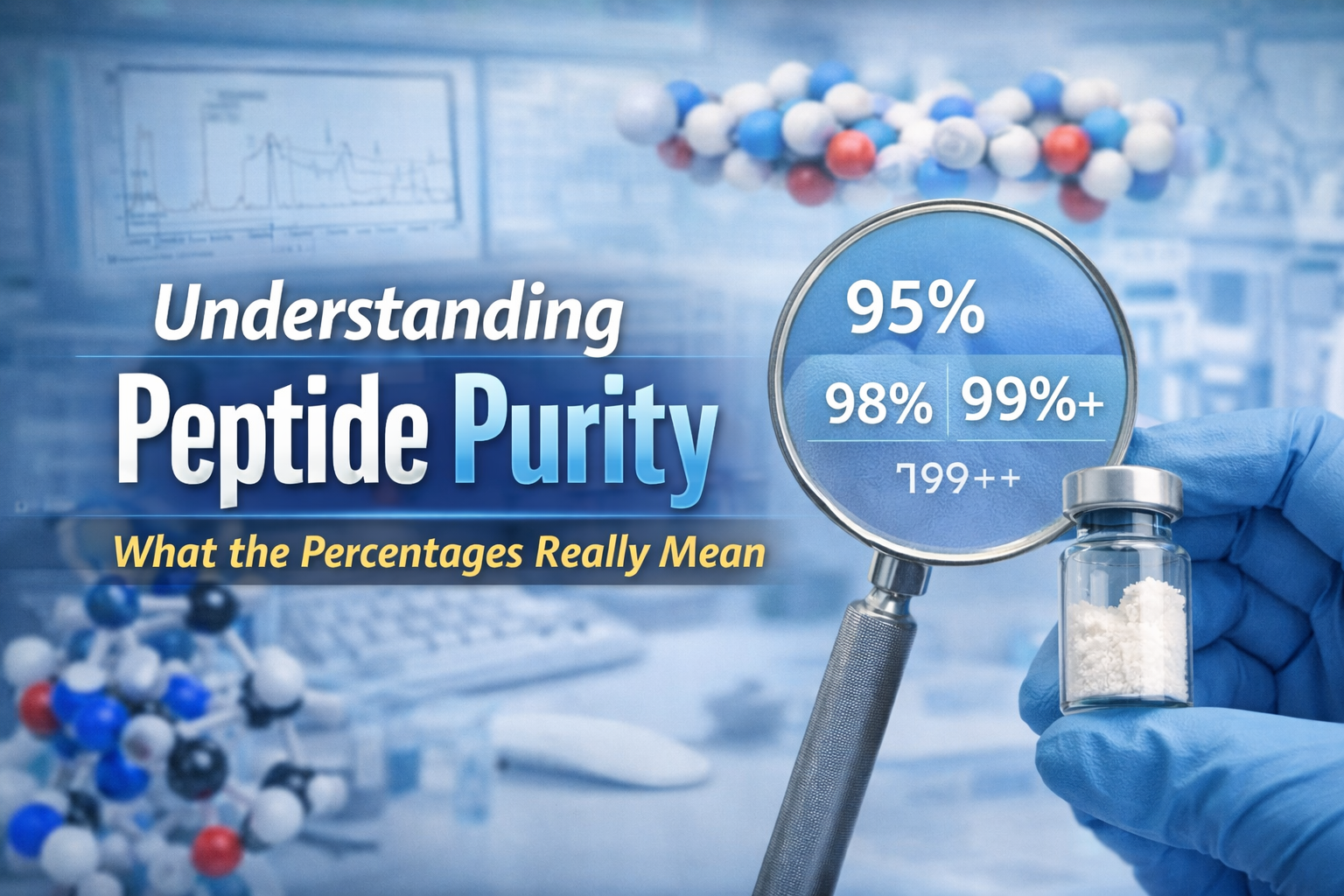
Peptide Purity Degrees Clarified-- What 98%, 99%, And "Research Study Grade" Actually Indicate
We employ GC-MS, ICP-MS, and other approaches to identify contaminations, making sure product safety and security and governing compliance. Peptide sequencing is crucial for identifying the exact amino acid sequence of peptides, consisting of modifications like phosphorylation or acetylation. Sequencing enables scientists to comprehend the biological function of the peptide and its communication with various other particles, helping in the style of practical peptides for diverse applications. The peptide sample is liquified in a suitable solvent and filled into an autosampler.
In addition to HPLC and MS, specialized laboratories may utilize orthogonal strategies for included precision. For example, capillary electrophoresis can be made use of to divide very hydrophilic peptides or to confirm outcomes, and MALDI-TOF mass spectrometry can help in mapping bigger or modified peptides. Numerous peptide producers or vendors will provide a COA (Certification of Evaluation), as an example our bpc 157 tb 500 mix, that consists of the purity percent by HPLC and identity verification by MS for each batch. Top-tier labs usually report peptide purity well above 95%, often ≥ 98-99%, by using cutting edge HPLC and MS evaluations. They also check both basic materials and completed peptide vials, which aids capture any impurities, degradation items, or solution inconsistencies. It is an area-percent pureness dimension, not a full identification or task examination. Importantly, purity portions explain chemical structure only-- they do not suggest sterility or biological viability. Peptides from Maxed Out Substances are supplied solely for lab research usage and are not intended for human or veterinary functions. Peptide pureness is usually shared as a percent, such as 95% or 98%. This figure stands for just how much of the sample is composed of the preferred peptide series. For most research laboratory applications, a purity of 95% or higher is thought about research-grade.